

Executive Summary
The Capital Requirements Directive VI (CRD VI) introduces, for the first time, a harmonised EU-wide minimum prudential framework for third-country branches (TCBs), i.e. EU branches of banks headquartered outside the European Union. The regulatory core of this framework lies not in the Capital Requirements Regulation III (CRR III), but in the new CRD VI provisions governing market access, authorisation, classification, capital endowment, liquidity, governance, booking arrangements, and reporting. From 11 January 2027, third-country banks will generally be required to establish an authorised EU branch in order to provide “core banking services”—notably deposit-taking, lending, and guarantees—subject only to narrow exceptions such as interbank and intragroup transactions or reverse solicitation.
This development is strategically significant for non-EU banks, as it materially restricts the previous ability to serve EU clients purely on a cross-border basis. In addition, the new regime introduces a tiered supervisory model under which Class 1 branches are subject to more stringent requirements than Class 2 branches, while national authorities retain the power to require subsidiarisation in certain cases. Importantly, third-country branches do not benefit from passporting rights, reinforcing the territorial nature of EU supervision. As of April 2026, the Level 1 framework is final, but several Level 2 and Level 3 measures developed by the European Banking Authority remain non-applicable or not yet finalised, meaning that while the overall direction of travel is clear, the operational detail is still evolving.
1. Introduction
A third-country branch is defined as a branch established in a Member State by a credit institution whose head office is located outside the EU.
CRD VI forms part of the broader CRD VI / CRR III package implementing the final Basel III reforms in the European Union. While CRR III focuses primarily on prudential requirements applicable to EU credit institutions, CRD VI significantly expands the scope of the directive by introducing a dedicated framework for third-country branches. A third-country branch is defined as a branch established in a Member State by a credit institution whose head office is located outside the EU. Unlike subsidiaries, such branches do not have separate legal personality and remain legally and operationally part of the third-country parent institution.
2. Pre-CRD VI Landscape
Prior to CRD VI, the regulatory treatment of third-country branches was largely determined at national level, resulting in a fragmented supervisory landscape across the EU. Although certain minimum requirements existed under earlier versions of the Capital Requirements Directive, there was no comprehensive harmonised regime governing authorisation, prudential standards, or supervisory cooperation.
This fragmentation gave rise to several concerns. Authorities such as the European Central Bank and the European Banking Authority highlighted risks of regulatory arbitrage, whereby third-country banks could select jurisdictions with more lenient requirements. In addition, the absence of consistent supervisory standards led to uneven oversight of branches belonging to the same banking group across different Member States, reducing transparency and potentially undermining financial stability. The scale of third-country activity in the EU is significant, with hundreds of non-EU banking groups operating through branches, further reinforcing the need for a more coherent regulatory approach.
3. CRD VI Framework for Third-Country Branches
Under CRD VI, third-country branches are subject to a harmonised authorisation regime aimed at strengthening supervisory oversight and reducing regulatory fragmentation across the EU. Branches must obtain authorisation from the competent authority in the host Member State, and the activities performed must align with the licence held by the parent institution in its home jurisdiction. The framework also places significant emphasis on supervisory cooperation, transparency, and anti-money laundering controls.
A central feature of the regime is the introduction of a tiered classification model for third-country branches. Branches are categorised as either Class 1 or Class 2 based on a combination of quantitative and qualitative criteria, including asset size, retail deposit-taking activity, AML risk exposure, and the equivalence of the home-country supervisory framework. This classification determines the level of prudential requirements and supervisory scrutiny applied to the branch.
Key Classification Criteria
- Class 1 classification applies to branches with:
- At least €5 billion in booked or originated assets
- Significant retail deposit-taking activity
- Exposure to AML high-risk jurisdictions
- Non-equivalent home-country supervisory regimes
- Class 2 classification applies where these thresholds are not met
- Classification drives prudential, governance, and supervisory expectations
CRD VI also introduces minimum capital endowment and liquidity requirements designed to ensure greater local financial resilience. Capital must be maintained locally in eligible ring-fenced assets, while branches are also expected to maintain sufficient liquidity to withstand short-term stress scenarios.
Capital & Liquidity Requirements
- Class 1 branches:
- Minimum capital endowment of 2.5% of average liabilities
- Minimum capital floor of €10 million
- Class 2 branches:
- Minimum capital endowment of 0.5% of average liabilities
- Minimum capital floor of €5 million
- Capital must generally be held locally in ring-fenced eligible assets
- Liquidity buffers required to cover 30-day stress scenarios
- Class 1 branches expected to comply with CRR Liquidity Coverage Ratio standards
Governance and internal control expectations are also significantly strengthened under the new framework. Branches must demonstrate meaningful local substance and effective management oversight within the host Member State.
Governance & Control Expectations
- At least two individuals must effectively direct the branch locally
- Enhanced governance and internal control frameworks required
- Greater supervisory focus on local management substance and accountability
- Further EBA governance guidance expected
CRD VI additionally introduces detailed booking and transparency requirements intended to improve supervisory visibility into branch activities and risk profiles.
Booking & Transparency Requirements
- Mandatory “Registry Book” for all booked and originated exposures
- Inclusion of off-balance-sheet exposures
- Formal booking policy required and approved by head office
- Supervisors may require independent compliance assessments
The framework also significantly expands regulatory reporting obligations, increasing the volume and granularity of information required from third-country branches.
Reporting Requirements
- Reporting obligations include:
- balance sheet information
- risk exposures
- intragroup transactions
- capital and liquidity positions
- deposit protection arrangements
- Proposed EBA framework may introduce:
- quarterly balance sheet reporting
- monthly liquidity reporting
Finally, CRD VI grants competent authorities the power to require subsidiarisation in certain circumstances, particularly where a branch becomes systemically important or poses broader financial stability concerns.
Potential Subsidiarisation Triggers
- Systemic importance or financial stability concerns
- Significant scale or EU market activity
- Activities extending beyond authorised scope
- Discretionary supervisory assessment by competent authorities
This evolving framework is expected to materially reshape the operating models, governance structures, and regulatory obligations of third-country banks operating within the European Union.
4. Supervisory Powers and Convergence
CRD VI strengthens supervisory coordination for third-country branches while leaving primary oversight with national competent authorities. The framework enhances cooperation across the EU, with the European Banking Authority supporting convergence through technical standards and guidelines.
Key Features
- National authorities remain primary supervisors
- Enhanced EU supervisory cooperation and information-sharing
- Supervisory colleges may apply to certain Class 1 branches
- EBA drives supervisory convergence through standards and guidance
Although the ECB does not directly supervise third-country branches, it continues to assess the broader implications for financial stability and EU banking market structure.
National Discretion Remains
- Member States may apply a “subsidiary-like approach”
- National implementation differences are likely to persist
- Full EU harmonisation is not expected

The new framework enhances EU-wide supervisory coordination, but national authorities continue to retain primary control and important discretionary powers.
5. Implications for Third-Country Banks
CRD VI forces third-country banks to reassess their EU operating models, local presence, and long-term structural strategy.
CRD VI is expected to significantly reshape how third-country banks operate within the EU. The absence of passporting rights means branches authorised in one Member State cannot serve clients across the EU, increasing pressure to reassess operating models and legal entity structures.
Key Implications
- No EU passporting rights for third-country branches
- Greater focus on local presence and substance
- Increased capital, liquidity, governance, and reporting requirements
- Higher operational costs and complexity
- Potential pressure toward subsidiarisation and restructuring
- Likely acceleration of EU operating model transformation and consolidation
6. Comparison with Other Jurisdictions
In the United Kingdom, the Prudential Regulation Authority continues to apply a “responsible openness” approach. This framework is more flexible and supervisory-driven than the EU’s rule-based classification system. While the PRA has introduced thresholds—such as an indicative level of £300 million in retail deposits above which subsidiarisation is generally expected—it remains more open to branch structures than the EU.
In the United States, the Federal Reserve System requires comprehensive consolidated supervision in the home jurisdiction and conducts ongoing oversight of the combined US operations of foreign banks, in coordination with other regulators such as the Office of the Comptroller of the Currency. Unlike the EU, the US does not operate a harmonised branch-specific capital regime, and its framework places greater emphasis on entry conditions and supervisory coordination.
7. Implementation Timeline
The CRD VI / CRR III package entered into force in July 2024. CRR III has applied since 1 January 2025, while CRD VI required transposition into national law by 10 January 2026. The new third-country branch regime will apply from 11 January 2027, although certain reporting and notification requirements may take effect earlier.
8. Key Uncertainties and Open Questions
While CRD VI establishes a clear regulatory direction, significant interpretive, technical, and implementation uncertainties remain unresolved.
While the Level 1 framework under CRD VI is now established, several legal, technical, and supervisory uncertainties remain. Further clarification is expected on the interpretation of reverse solicitation, interaction with other EU regulatory frameworks, and certain prudential calculations.
Key Areas of Uncertainty
- Interpretation of reverse solicitation rules
- Interaction with frameworks such as UCITS and AIFMD
- Technical treatment of liabilities and originated exposures
- Extent of Member State supervisory discretion
- Potential use of “subsidiary-like” approaches
- Risk of divergent implementation across the EU
- Ongoing concerns around operational complexity and consistency
9. How Banks Can Prepare
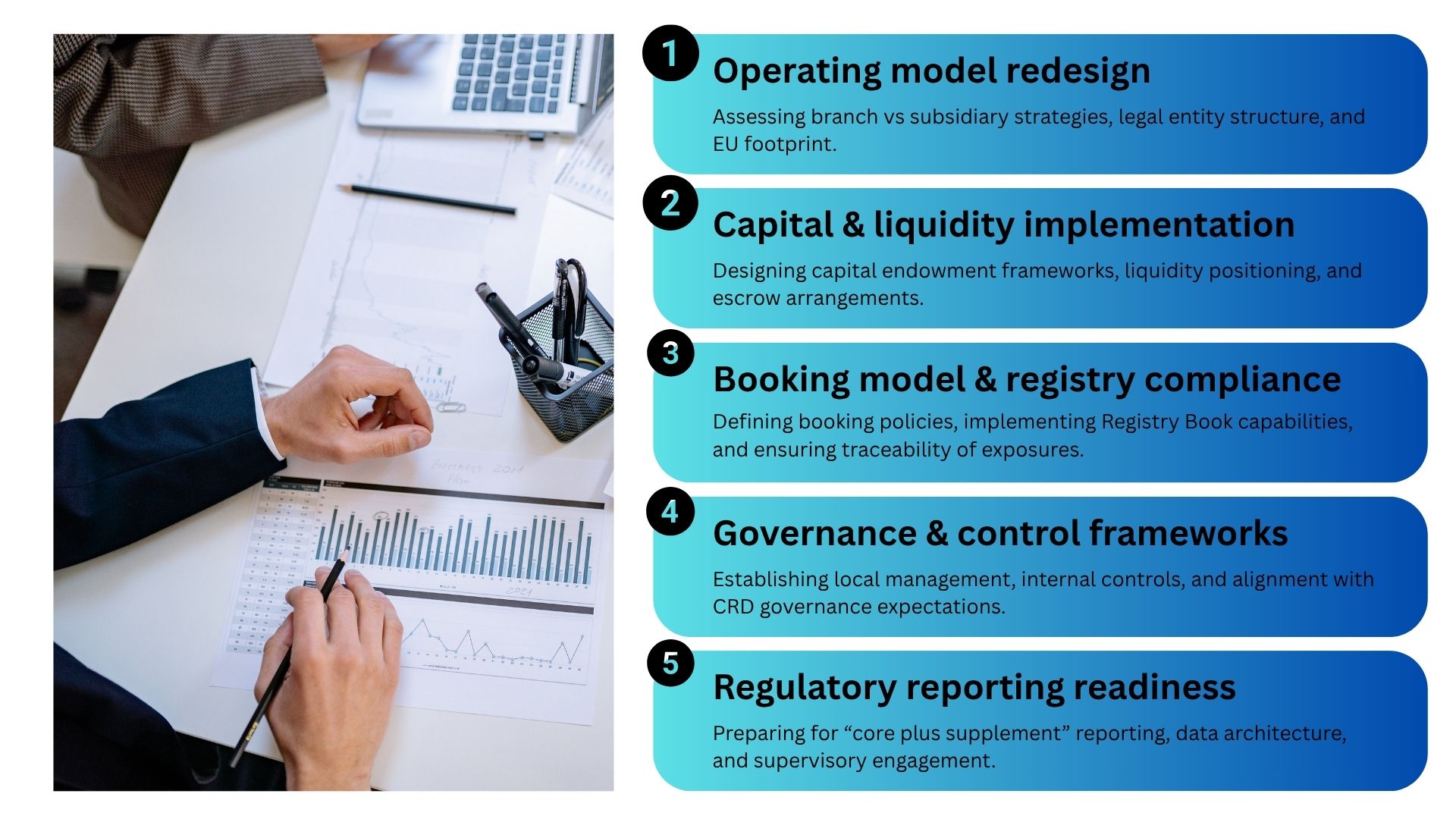
Third-country banks should already be mobilising across several fronts:
10. How Aspect Advisory Supports
Aspect Advisory supports third-country banks through:
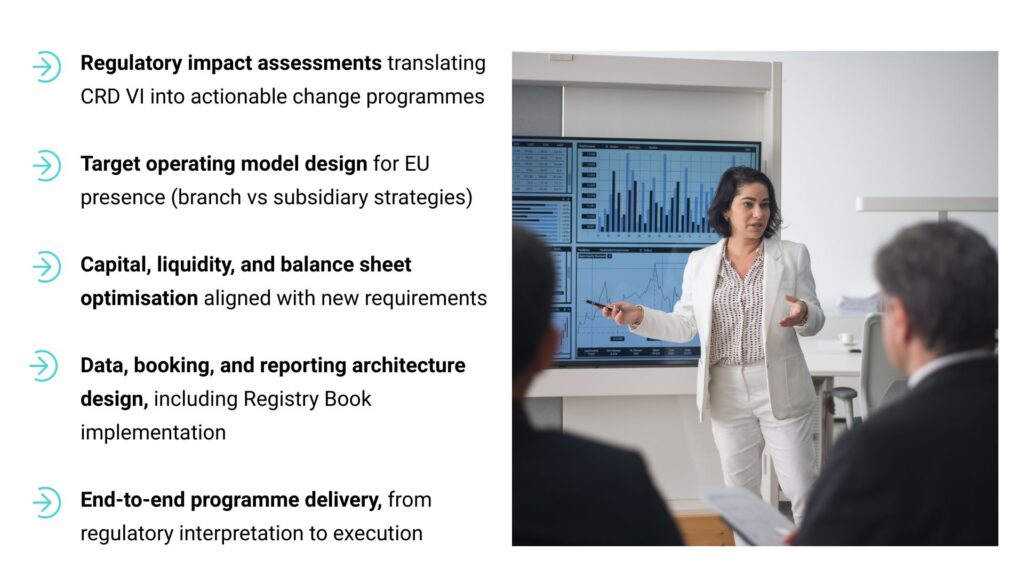
- Regulatory impact assessments translating CRD VI into actionable change programmes
- Target operating model design for EU presence (branch vs subsidiary strategies)
- Capital, liquidity, and balance sheet optimisation aligned with new requirements
- Data, booking, and reporting architecture design, including Registry Book implementation
- End-to-end programme delivery, from regulatory interpretation to execution
11. Conclusion
CRD VI represents a fundamental shift in the EU’s approach to third-country branches, replacing a fragmented national landscape with a harmonised minimum framework. The new regime strengthens supervisory convergence, enhances risk transparency, and imposes more stringent requirements on local presence and substance. For third-country banks, this entails significant strategic and operational adjustments, including potential restructuring of EU activities and increased investment in compliance infrastructure. While the overall framework is now established, the final shape of the regime will depend on the implementation of Level 2 and Level 3 measures and the approaches taken by individual Member States.
12. About the Author
Dario Ruggiero, CFA specialises in prudential regulation, regulatory reporting, and risk management within the banking sector, with particular expertise in Basel III / Basel IV, CRR II, CRR III, and MaRisk frameworks. His work focuses on the design and implementation of regulatory reporting and risk management solutions, including BAIS reporting environments, governance and process optimisation, and the translation of complex regulatory requirements into operational and technology-enabled frameworks. He also brings extensive experience in IT implementation, database analysis, and the treatment of financial instruments and derivatives within regulatory transformation programmes. His work includes supporting financial institutions in navigating evolving EU prudential and reporting frameworks.,
Contact us

Dario Ruggiero, CFA
Director,
Aspect Advisory
